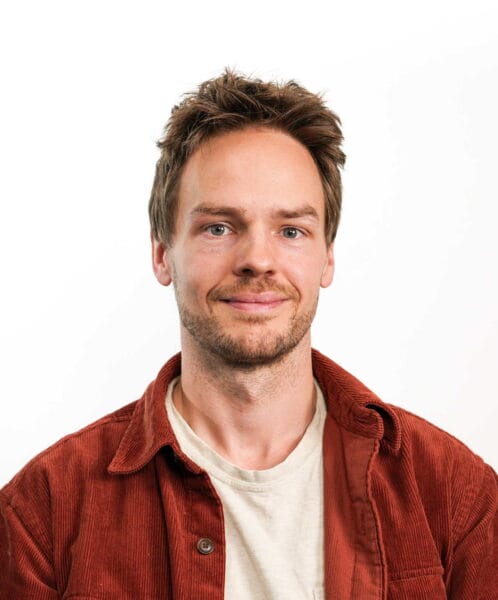
Pepijn Kennis is a true Brussels native who has worn many hats: activist for the temporary occupation of buildings, member of the Brussels Parliament, guest professor, recently Fellow in the 40u40 programme, and now project manager at Fair Ground Brussels. His goal is to (re)invent economic models to preserve or create affordable socio-cultural spaces in an increasingly expensive city. We meet a passionate man who sees cooperatives as a lever for transforming Brussels… and who, between meetings, travels around Europe by bicycle.
FGB: Hello Pepijn. Some of us may already be familiar with your face or your name, but could you tell us about your career path to date?
Pepijn: My career path is deeply rooted in Brussels, where I grew up and studied at the VUB. After completing a Master’s degree in urban studies which I pursued across several European cities, I joined the Toestand organisation. There, I worked on the temporary occupation of buildings, notably the Allée du Kaai project creating space for people who could not otherwise afford it..
In 2019, my career took a political turn through the Agora citizen movement, which had the somewhat radical idea of reshaping democracy by organising citizen assemblies with randomly selected people of Brussels. I was appointed head of the list and served for five years as a member of the Brussels Parliament. There, I defended deliberative and citizen democracy and worked intensively on the issue of affordable housing in particular.
I currently teach at the VUB and, since September, have been a Fellow in the Belgium’s 40 under 40 programme. With other fellows, I’m working to identify ways to create affordable spaces in the city, whether for housing or other types of spaces.
I am also continuing this commitment at Fair Ground Brussels.
What motivated you to move from being a board role to a project manager position within the cooperative?
I had been a member since 2022, then an administrator. What prompted this change is the ReBuild research project, funded by the Helios Foundation and realised with the VUB, Architecture Workroom Brussels and CityMin(e)d. We are responsible for developing concrete economic and financial models to create or maintain affordable socio-cultural spaces in an increasingly expensive city.
What are your priorities at FGB?
My main mission is to diversify FGB’s activities. Today, the cooperative relies heavily on the Social Real Estate Agencies model, which is both a strength and a weakness. I am therefore exploring ‘non-housing’: identifying sustainable models for community, cultural or social economy spaces that operate outside the speculative market. My priority for 2026 will be to find a specific building to actually test one of these models.
You also take a keen interest in European subsidies. What role do you think Europe should play in addressing the issue of affordable housing shortages?
The financialisation of real estate, where buildings become investment products rather than places to live, is a problem that goes far beyond Brussels. It is at the European level that we can best address the systemic causes, even if for the moment Europe is mainly tackling the symptoms through affordable housing funds. Part of my role is to explore these European funding opportunities to strengthen the cooperative’s social purpose.
What levers could be used to tackle the causes?
In Belgium, unlike in France, tax advantages and social economy levers are rarely applied to real estate, as this sector is perceived as purely speculative. There is still a lack of coordinated and effective lobbying to promote solidarity-based and social real estate. It doesn’t currently have a voice in the debate. Brussels is full of initiatives, but they are often isolated and each has to contend individually with the complexity of the Belgian institutional system. Together, we could make greater use of these political and tax levers.
What is your dream for FGB in five years’ time?
I would like to see the emergence of a network of affordable spaces where associations, volunteer groups and social economy actors would no longer have to worry about property management or renovations and could focus on their social mission, while helping each other out. A large-scale cooperative, pooling spaces and other resources to preserve the diversity and richness of Brussels.
To end on a more personal note, is there an anecdote about yourself that would surprise your fellow co-operators?
(Laughs) Perhaps the fact that I have made long international journeys by bicycle. This side of me, as a “cycling traveller”, is one that not everyone knows.